Pulse: The Heart and Soul of Your Community
August 7, 2026 · Krishna Kamath
Three hundred families joined. So when do the carpools start?
Admins ask us some version of that. It's a fair question, and a counter can't answer it. The number tells you what happened. It doesn't tell you whether anything is happening. So we rebuilt the admin metrics page around a different question: is this community alive?
The page used to be called Impact. It's now called Pulse, and the rename is the point. Impact is a report card. Pulse is a vital sign. (Pulse lives in the staff-led admin portal today. If you run a parent-led community, the vital signs and the work are the same.)
A carpool community is a living thing. It has a heart: the families in it. It has a soul: the relationships between them. A community can have a large heart and no soul: plenty of signups, nobody talking. That is a mailing list, and mailing lists do not carpool.
Carpools are what happens when both are healthy, so Pulse is built in that order: first the heart, then the soul, then the rides that follow.
The heart: critical mass
A family can only share a ride with a family whose home and schedule overlap with theirs. Forty families scattered across a county are weaker, for carpooling purposes, than twelve families in two neighborhoods. Critical mass builds neighborhood by neighborhood.
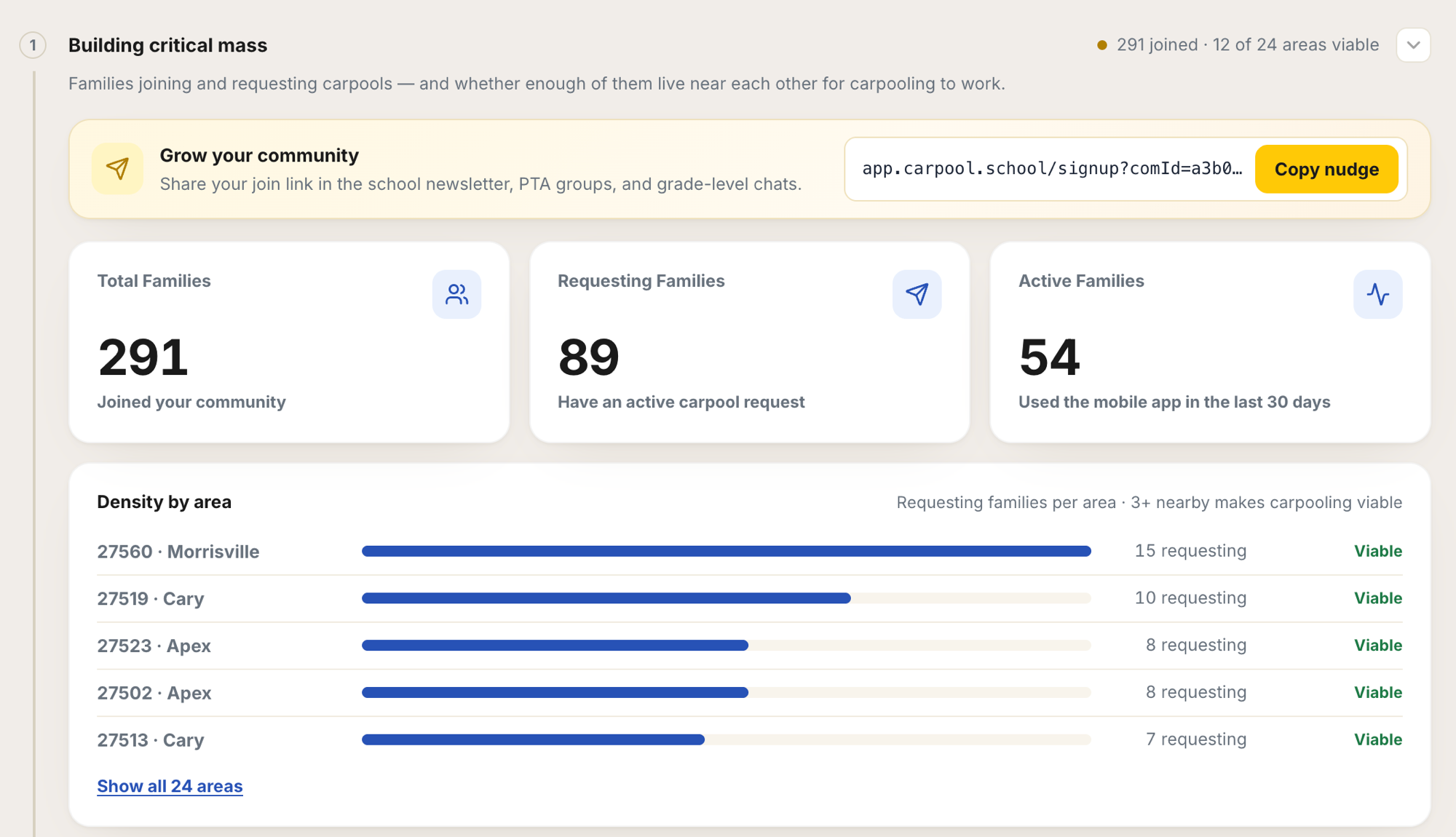
A signup total says the community is growing. It doesn't say who's actually here. Some families join out of curiosity, a few even file a carpool request on the way in, and then never open the app again. So Pulse looks past the total: how many families are asking for rides, how many are actually in the app, and whether enough of them share the same areas. The bar is a cluster of requesting families in an area; that's where carpools become possible.
For an admin, the goal is a bigger total in the right places: every area on the map turning viable. A newsletter blurb aimed at the whole school helps. Knowing which areas are a family or two short tells you where that ask matters most.
The soul: engagement
A family likes someone's carpool request. Another answers a message. Two families connect. Small acts, and every one of them is a stranger turning into an acquaintance.
Those acquaintances matter more than they seem. Close friends mostly know the same people and the same options you already do; it's the acquaintances at the edges of your network that carry something new. Sociologists call these weak ties, and fifty years of research says new opportunities travel through them. We covered that research in Why Some Communities Carpool and Others Don't.
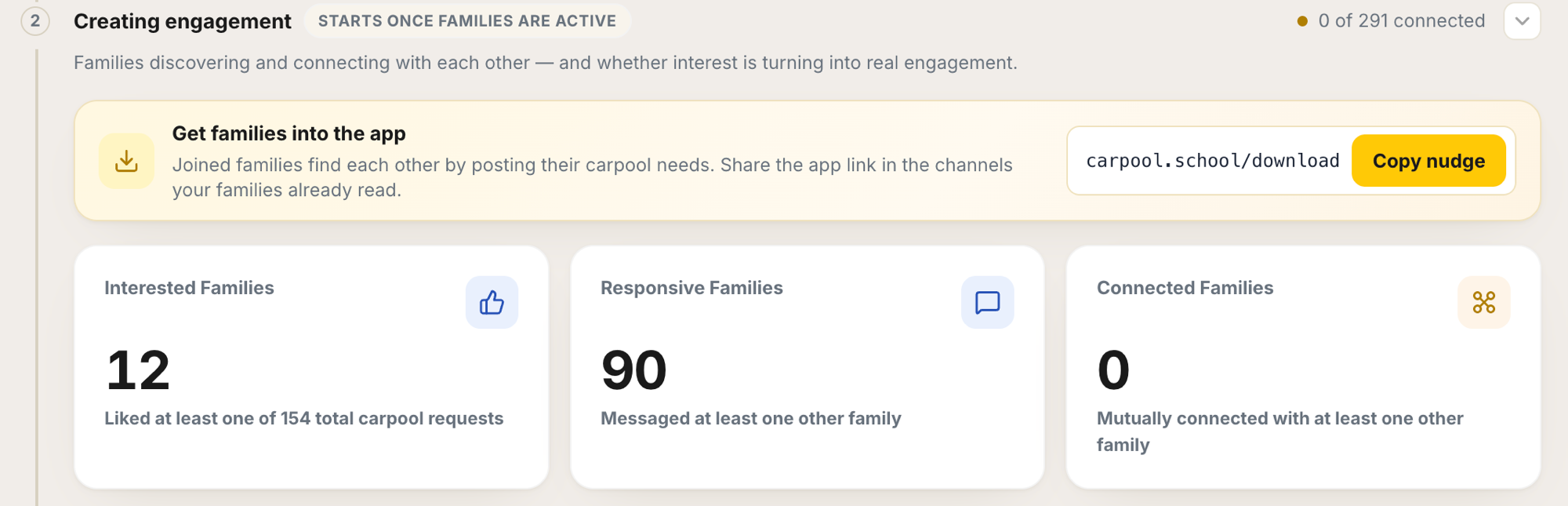
We hold this phase to a high bar: the goal is every joined family connected to at least one other. One pair talking is a start, not a community.
For an admin, the work here is simple to name and slow to do: get joined families into the app. A family that never opens it can't be discovered by the neighbor looking for them.
This phase is ours to work as well, not only the admin's. Families join at different times, so the parent who found no match in their first week may have one waiting a month later. Each week we email parents what changed while they weren't looking: who joined nearby, who shares their kids' activities. And parents can turn those emails off any time, because the boundary is the same for us as for admins: participation can be invited, never forced.
Reading a slow pulse
Every community starts the same way: a slow beat. One family joins. Then another. A first message. A first connection. Weeks can pass between beats, and at that stage the numbers all look discouraging if you read them as a report card.
Read them as a pulse instead. A slow beat is not failure. It's how every heartbeat starts. The question is not "is it fast yet," it's "is it getting steadier."
No one can say exactly what turns a slow beat into a rhythm; communities are made of people, and people are not mechanisms. What we do know is which levers exist. Technology makes each beat possible: it surfaces nearby families, carries the request, makes the first message low-stakes. The admin keeps the beats coming: sharing the join link where parents already read, nudging families into the app, giving the heart a push when it slows. Neither works alone.
The habit is the goal. A community where families check for rides the way they check the weather doesn't need its admin anymore. That is the sustained beating heart, and it is the point at which your job, as the person who started it, quietly disappears.
The Pulse page in your admin portal reads these vital signs for your community: the heart, the soul, and what to nudge next. If it shows a slow beat today, good. That is a heartbeat. Keep it going.